

Andrea Randisi has lived in China since 2024. His @italyukchina TikTok has 75,000 followers but an impressive 2.4 million likes. Content is mostly cliché “China wow” fare, thumbnails of him looking dumbfounded. He advertises local products like Huawei, and AITO. He’s sponsored by a VPN.
In September, Randisi landed in Xinjiang, for a week-long trip. “Before visiting Xinjiang, I had heard a lot of negative stories about how Uyghurs and other minorities live in China,” he explains. “For years I had only heard one version of the story. So I decided to go and see it for myself.”
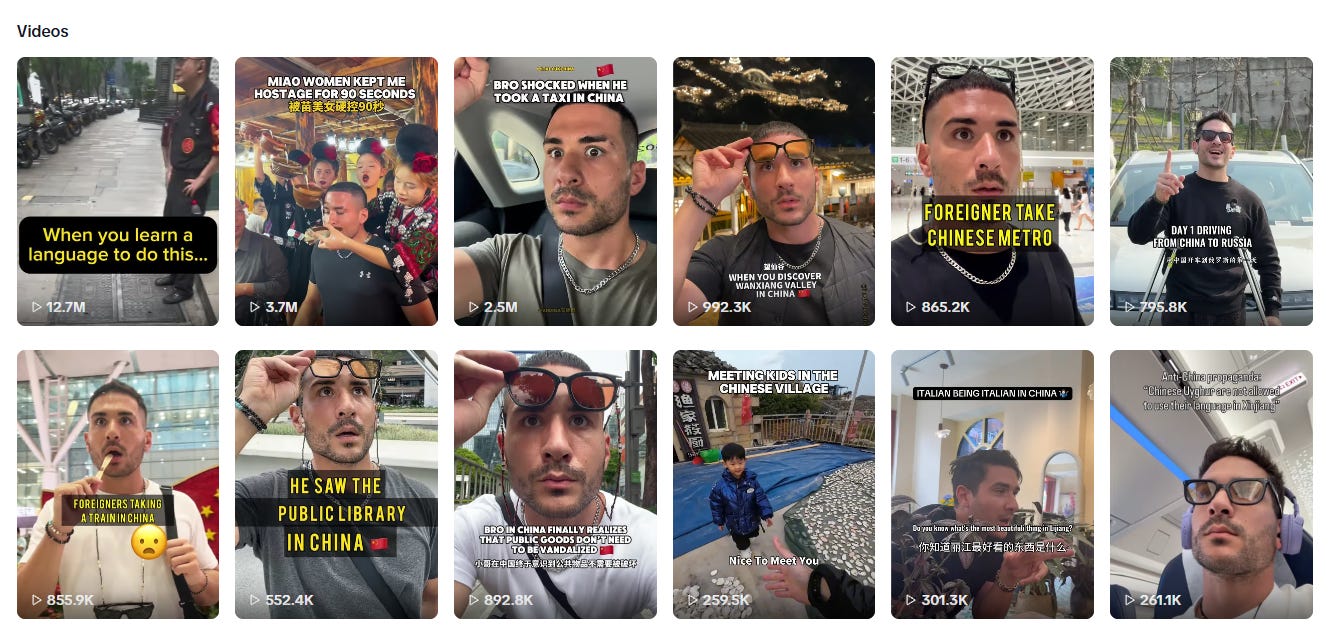
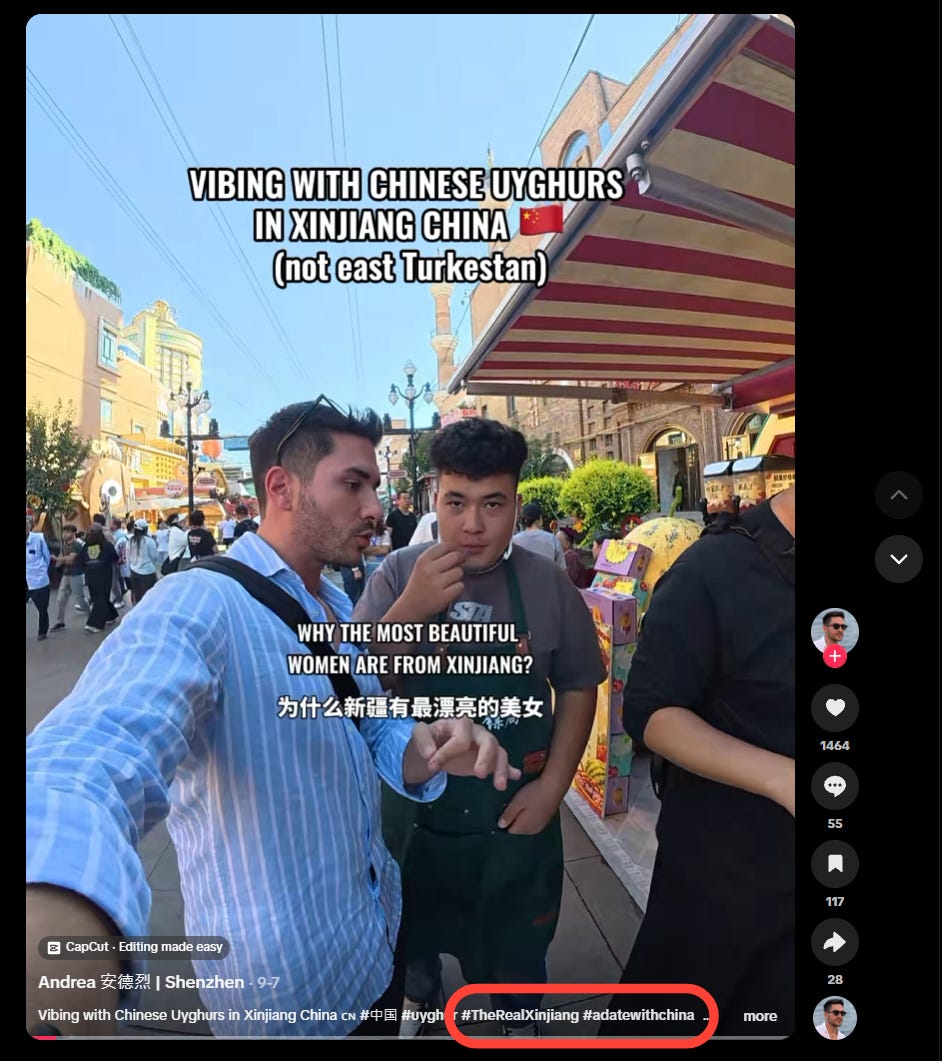
His initial investigations are distracted. “Why are the most beautiful women from Xinjiang?” he asks a stallholder in one video. “I think the most beautiful women all come from here,” he tells another. And another. For a man hoping to humanise a region, he’s sure doing a good job of flattening its people to a single dimension — namely if his penis wants them or not.
But after just a few days and seven videos in Xinjiang — a region five-times the size of his native Italy — Randisi feels comfortable drawing a conclusion. “Contrary to Western media and their “CIA parrots” narrative, their culture is not being oppressed,” he decrees.
The video carries the hashtags #TheRealXinjiang #adatewithchina #GoChina — and that’s the tell. You see, those markers are contractual. One thing Randisi doesn’t mention is that this trip was organised and funded by the Communist Party of China.
The Tours
He’s not the only one.
“Western media told me everyone is in prison camps in this part of China” states one attention-grabbing Instagram video. It has 1,100 likes.
Regular readers might remember the creator. He’s Bradley Krae, the American who wrote an autobiography about his first time in China, featuring stories like working illegally, nights in prison, or fleeing when his drug dealer was arrested. Not only has he shrugged those hiccups off, but he’s been elevated to a tour to Xinjiang, funded by the Chinese state.
If Krae’s content feels familiar to Randisi’s — horse riding, the Grand Bazaar, dancing — it’s because they were on the same tour.
It’s called the “A Date With China / Meet Xinjiang International Media Tour”, and this particular branch features 16 foreigners from 13 countries. Other names on it include including Jason Lightfoot from the UK, and Karyna Kovalevska from Ukraine.
“Xinjiang is often portrayed in Western media as one of the most controversial and restricted regions in China. But what does it actually look like when you travel there yourself?” introduces Jason. The video is about Tacheng city and titled: “BBC Won’t Show this Side of Xinjiang … so I Will!”.
In it, he has the sense to remove his tour lanyard, given to him by organisers, and positions the camera so other influencers are rarely seen, but keep your eyes peeled and they can sometimes be seen in the background, alongside state media and the organisers.
Their tour is being run by the regional branch of the Cyberspace Administration of China (CAC), aka the CPC Bureau responsible for “content management” and “censorship” of the internet. It is the architect behind China’s “Great Firewall”. Last month, a local CAC meeting, while discussing propganda efforts, declared: “The internet should be the front line of ideological work.”
At the campaign’s launch event in Urumqi, on August 25, Lightfoot, Randisi, and other foreign influencers joined Party officials and CAC organisers on stage.
Reports of the launch event were carefully disseminated. So, for example, China Daily limited coverage to just its Chinese site. While The Workers Times, a Party newspaper directed mainly at itself, let the handbrake off. It excitedly pointed out how the foreign influencers could provide “new paths for disseminating Xinjiang’s story beyond immediate audiences”. Quite.
It’s far from the only scheme. There’s the “Xinjiang in this Moment” tours, run jointly by Xinhua News Agency and the Information Office of Xinjiang, i.e. the regional government’s press department.
Or “Xinjiang Vibes”, run by the China Media Group, the massive conglomerate behind CCTV, CGTN, CRI, etc.
Attendee, British vlogger Lee Barrett, is a veteran of these tours. He joined a group of 20 influencers from 14 countries, visiting Tacheng Prefecture, between Sep 15 to 21. He told state media: “This trip completely changed my previous understanding of Xinjiang. I saw modern factories operating efficiently, mechanized harvests in the fields, and people of different ethnic groups singing, dancing and laughing together.”
The article also noted:
“Everyone expressed their commitment to leveraging social media to spread the natural scenery, unique culture, and industrial development stories they witnessed in Tacheng Prefecture in a way that resonates with overseas audiences, telling the world the true and moving stories of Xinjiang.”
That they did. On Sep 25, Barrett uploaded a video to his YouTube titled “Forced Labour or Full Automation? Inside Xinjiang’s Cotton Fields”.
The first hashtag was the name of the tour: #xinjiangvibes.
It’s hard to underscore the explosion of state-run media tours to Xinjiang this past month. I’ve counted citizens from: USA, UK, France, Germany, Italy, Sweden, Russia, Ukraine, Poland, Hungary, Serbia, Canada, Australia, Hong Kong, Pakistan, South Korea, Thailand, Vietnam, Tanzania, Uganda, Maldives, Cuba, Brazil, Guatemala, Venezuela and more.
Why Now?
This current spike can be traced to July 1, when the Chinese Government enacted its new Ethnic Unity Law.
Global reaction caught Beijing completely by surprise. It felt as if it had addressed the issue in March, when the policy was adopted at the Party’s annual congress. Then, state media spent huge effort into producing cosy packages selling it. By July, it expected little pushback from the world. They were wrong.
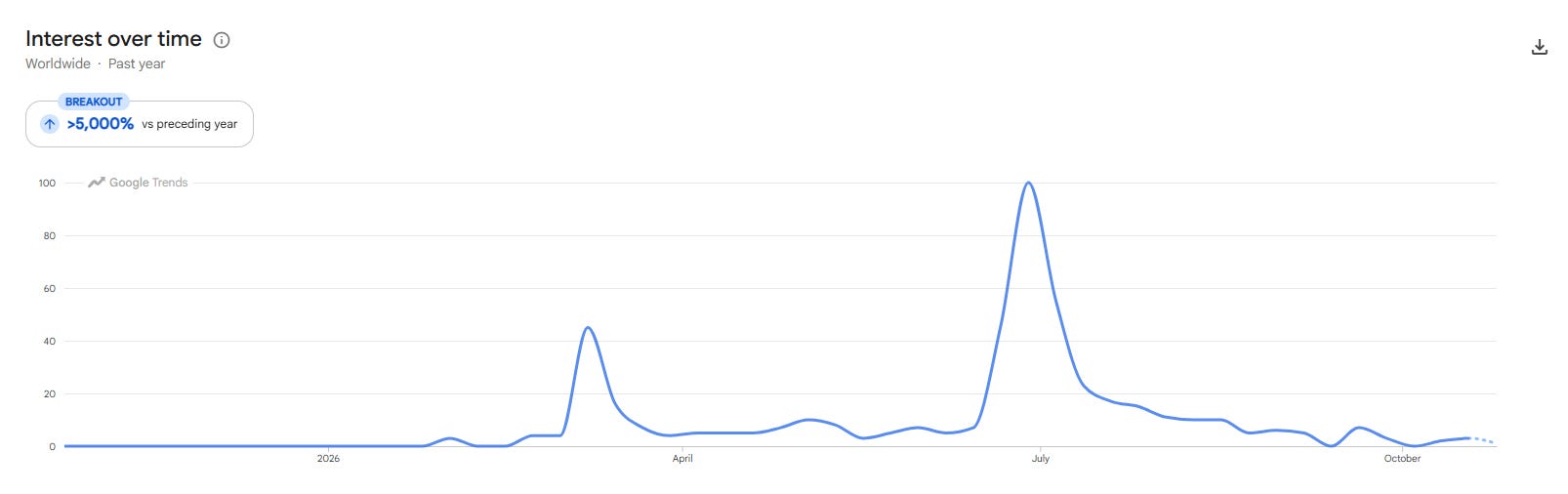
Global interest was twice the size. Media and human rights groups highlighted how the new law forces minorities to assimilate, or how it allows the Chinese state to target opponents overseas. To critics, the Law appeared to encapsulate all the worst excesses of the CPC — paranoid, clunking, interfering, terrified of independence. Take Article 46, which states religious groups must “persist in Sinification”, promote a “socialist society” and promote “patriotism”.
It was all a haltering brake to recent feelgood stories about “China-Maxxing”, or dancing robots, that have boosted China’s PR image of late.
Stung, Beijing sought to belatedly react. By August and September, these influencer tours were ready.
Summer Holiday
One foreigner spending weeks touring Xinjiang in an RV with his young family is odd. Two is odder.
This summer, Arnaud Bertrand, a Frenchman who lives in Malaysia, took the unusual step of packing his young family into a mobile home and spent 44 days touring Xinjiang. Along the way, he broadcast the trip to his 400,000 followers on X. For his 38,000 Substack followers, he wrote an article titled: “The most lied about place on earth”. This was reprinted by the nationalistic but independent Chinese news outlet Guancha “with the author’s permission”. One passage roughly reads:
As for the camps, we have seen nothing at all throughout our trip. I personally believe that when the Chairman of Xinjiang announced in December 2019 that all trainees have graduated and the training program had concluded, he was telling the truth.
By sheer coincidence, his holiday coincided with a 30-minute sit-down interview with Li Fangfang, from the Beijing Review. Though on X, Li disguises her state links, calling herself “Beijing journalist” Frieda Li from the “Fang Wen” studio. [«see here» for more on how China uses anonymous Media Studios].


Also on his travels was Daniel Dumbrill, a Canadian, who’s lived in China for nearly 20 years. He, too, packed his young family into an RV for a road trip around Xinjiang. “Why would you go to Xinjiang and have someone else arrange your itinerary for you?” he later tweeted.
On Aug 31, China Daily journalist Chen Weihua messaged Dumbrill on X, “I’m on way to Xinjiang next week.”
“Are you on the MFA trip? If so, I’m joining the Aksu group,” Dumbrill replied.
MFA stands for the Ministry for Foreign Affairs.
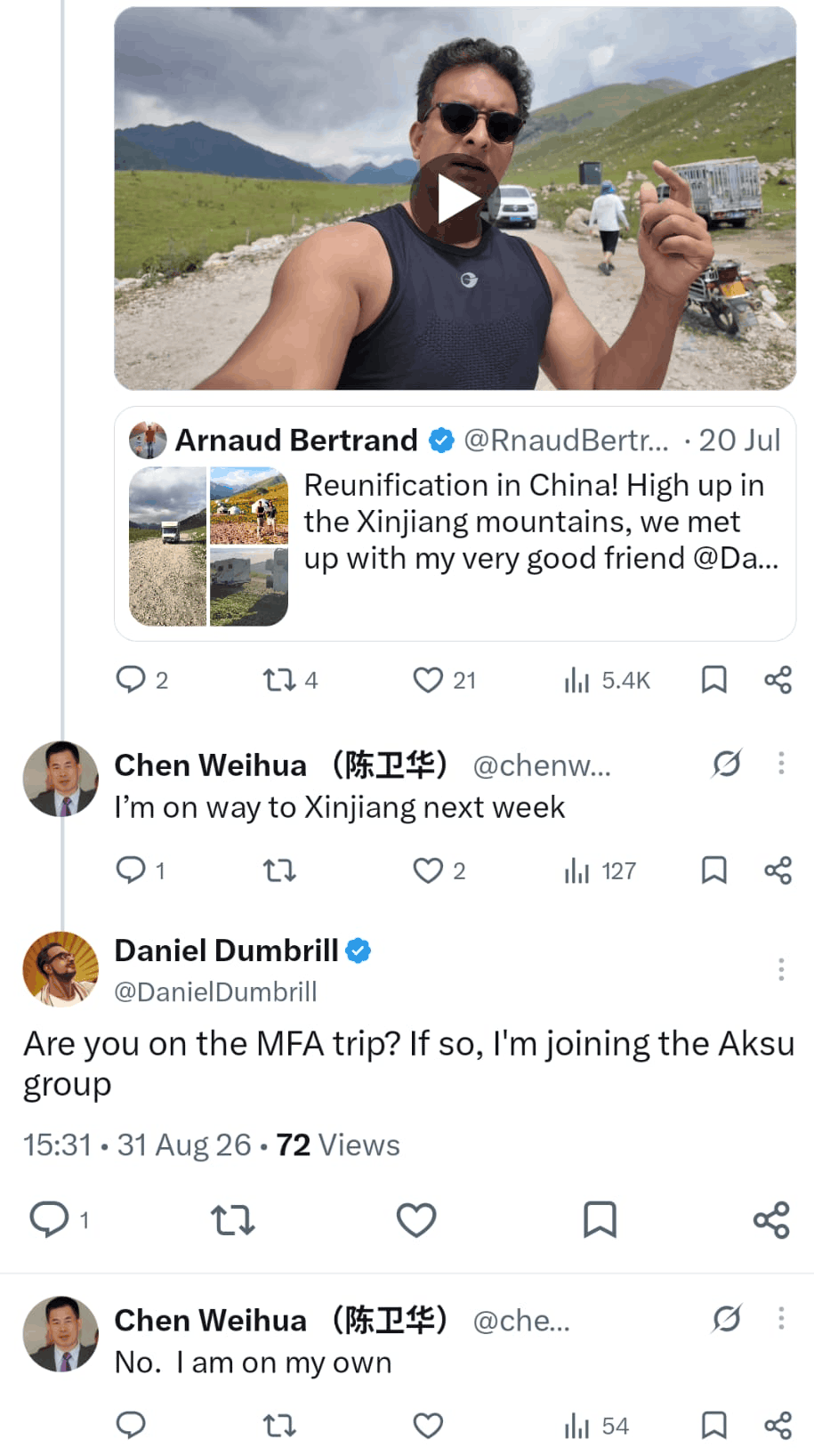
That trip would be between Sep 5-6, when Dumbrill joined other foreigners on a state-funded trip to Aksu, being shown cotton fields, night markets, and dancing.
According to state media: “Dumbrill said the trip refreshed his understanding of Xinjiang as a place where social stability, beautiful harmony among people of all ethnic groups live a happy and prosperous life.”
The article went on to note:
“All the influencers said they would make good use of overseas social media platforms to tell vivid and engaging stories about Xinjiang when they return home.”
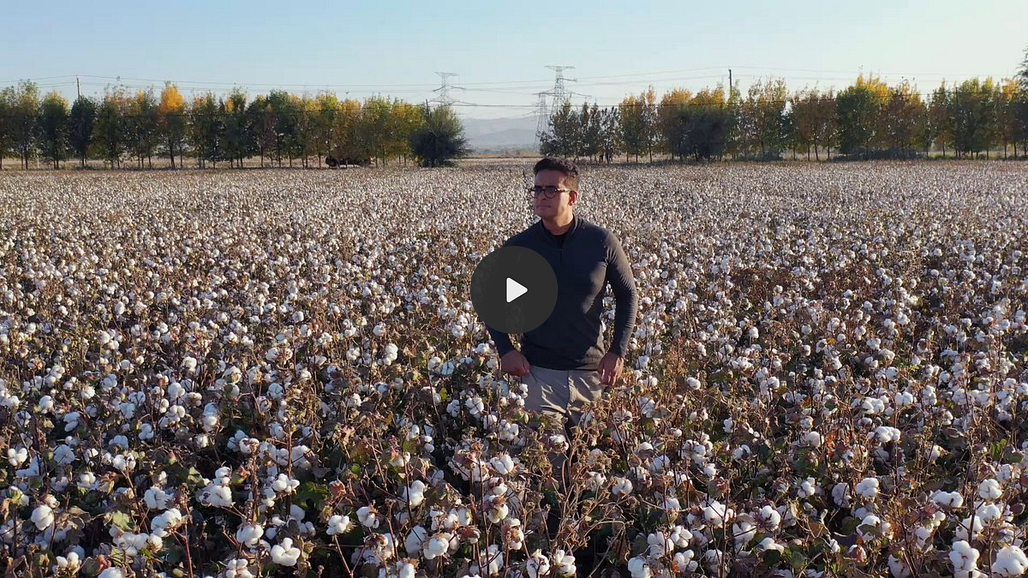
That he did. On Oct 19, Dumbrill posted a preview video of himself observing Xinjiang’s cotton harvest in Manas County, Xinjiang, glossily filmed by state media. Curiously, to publicise it, he dug out a week-old tweet by the MFA spokesperson Mao Ning. A hat tip to the grand organiser, perhaps?


The Side Not Shown
While foreign influencers’ social media videos have played up the freedom, independence, and diversity of the region, the CPC are delivering a very different information campaign at home.
To accompany the launch of the new Ethnic Unity Law, national state media produced a series of ‘explainers’ to hammer home its key messages. Like this, from China News Network:
“Article 6 stipulates: “enhancing commonality and respecting and embracing differences,” placing “enhancing commonality” first and establishing “unity” takes precedence over “diversity” in legal norms.”
Unity: first. Diversity: afterthought. Got it.
It’s a shame the influencer tours who visited Tacheng left so soon — else they could have immersed themselves like true locals. Just days later, the local CPC and United Front Work Department began the city’s first ever “Law on Promoting Ethnic Unity Week”.
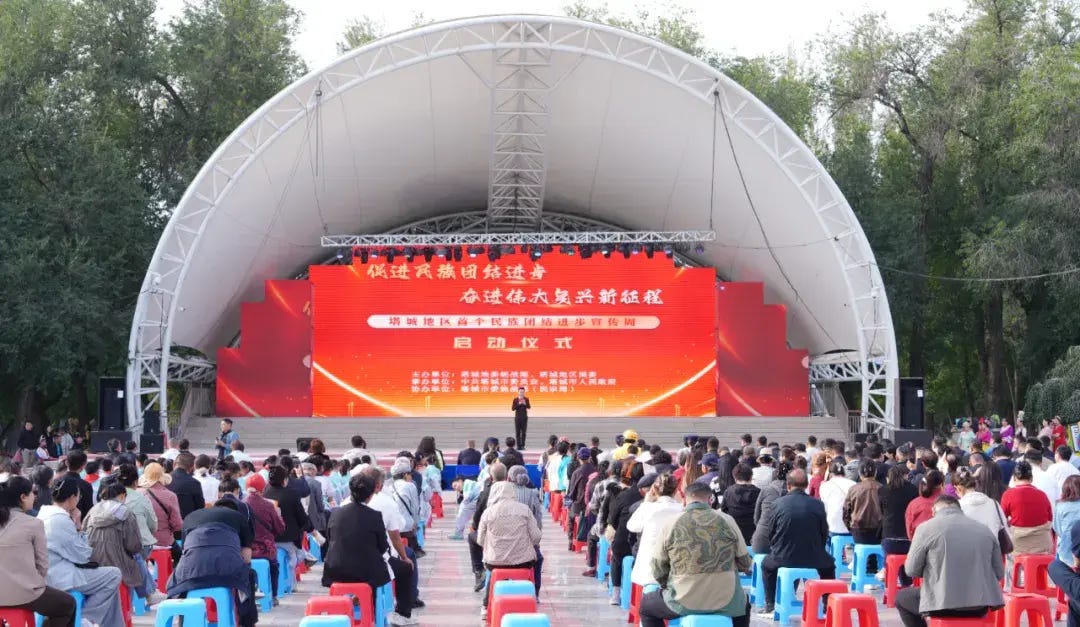
Far from celebrating diversity, emphasis was instead placed on minorities — about 40 percent of the city — “fitting in” with the Han majority. Attendees sang patriotic songs like “My Motherland and I”, or took part in Chinese writing competitions. All the Uyghur and Kazakh script that influencers were at pains to point out suddenly felt very absent.
“We will use the publicity week to vigorously promote the ‘Law of the People’s Republic of China on Promoting Ethnic Unity and Progress,’ and guide people of all ethnic groups to establish a correct view of the history of the Chinese nation,” promised a local cadre.
Then there are places influencers were not shown. Like the three local sites international researchers and ex-detainees have identified as detention centres, used for Tacheng’s “strike hard” campaign.
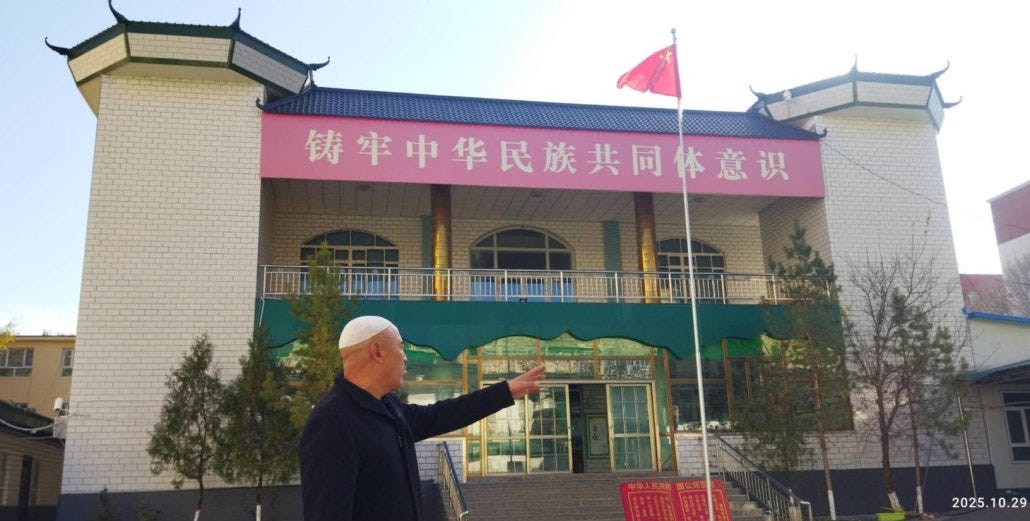
Nor did they have a chance to swing by the city’s Xinhua Street Mosque, which since 2016 has had its minaret domes removed as part of the region’s de-Islamification campaign. In further acquiescence, it is now emblazoned with a large, red President Xi quote.
Dumbrill, too, while touring cotton fields in Manas, was a short cab ride from the nearby Shihezi detention centres. The facility features dormitories, schooling and industrial buildings — surrounded by a large concrete wall, two layers of barbed fencing, and guard towers. A high-security prison sits a few hundred meters away.
The facility is far from abandoned. Google satellite imagery from this year shows it still in use, with crowds of people across the grounds.
Evidence exists. Maybe they just choose to look away.
Cash Prizes
According to influencers I’ve spoken to, but will keep anonymous, who have been on similar campaigns, the tours themselves are often unpaid. Attendees are remunerated via luxury hotels, experiences, and expenses. These can be generous, but not life-changing — a few thousand yuan (hundreds of dollars), in cash, stuffed into a hongbao red envelope, and smuggled into a goody bag of gifts.
Monetisation mostly comes from the back end — from the influencer’s social media accounts. Here, the Chinese state often helps via amplification, helping to boost views and pay-outs. It’s clever. The CPC has found a method where social media platforms both host and fund its propaganda.
Though renumeration comes in other ways too.
In April, Jerry Grey, a British-Australian retired police officer now living in Guangdong, took a break from giving his “Take on China”, a pro-CPC political series he fronts on YouTube, to upload a montage of him and his wife cycling across Xinjiang.
“Experimenting with a new format here and might enter this video in a competition… #RealXinjiang #SharetheRealXinjiangwiththeWorld #万人说新疆” Grey writes underneath.
Grey had the good sense not to translate the last hashtag, as it’s rather too obvious. It translates as “10,000 people talk about Xinjiang” and is the name of a state-funded competition he’s entering.
It too, is run by the Xinjiang Cyberspace Administration. And is another covert way the Chinese Government financially rewards those who help spread its messages. Grey’s video was selected as a winner for the 5th edition, and was subsequently pushed by state media.
This year’s contest offers 221 prizes, ranging from 500 RMB to 10,000 RMB ($75 to $1500) after tax. Rules say the content should focus on issues like “tourism”, “social development” or “Ethnic Unity”. AI use is encouraged. Content must be uploaded to social media and marked with the hashtags #TenThousandPeopleTalkXinjiang, or #RealXinjiang #SharetheRealXinjiangwiththeWorld to be eligible.
Most people mentioned in this article are previous winners.
“23 billion views”
So what’s the impact? According to China: huge.
According to China Daily: “Since its launch in 2021, the “Ten Thousand People Speak of Xinjiang” events… have amassed 1.34 million original short videos from home and abroad, covering 15 languages and reaching 35 countries and regions. The total number of views across the internet has reached 22.94 billion.”
Meanwhile, CMG boasts its campaign topped 1.1 billion views online.
CMG also notes that its “Xinjiang Vibes” managed to leap from social media onto TV networks, including: Vietnam National Television, Pakistan National Television, India’s Telekom Television, and Afghanistan’s STRNEWS Television —a reminder that while the West may be hesitant to accept Chinese propaganda, it often finds traction in the Global South.
“Its viral success stems from an innovative approach to communication: handing the camera over to bloggers from both China and abroad, allowing them to see and tell the story in their own way.” CMG Report.
These are big numbers. But are they even real?
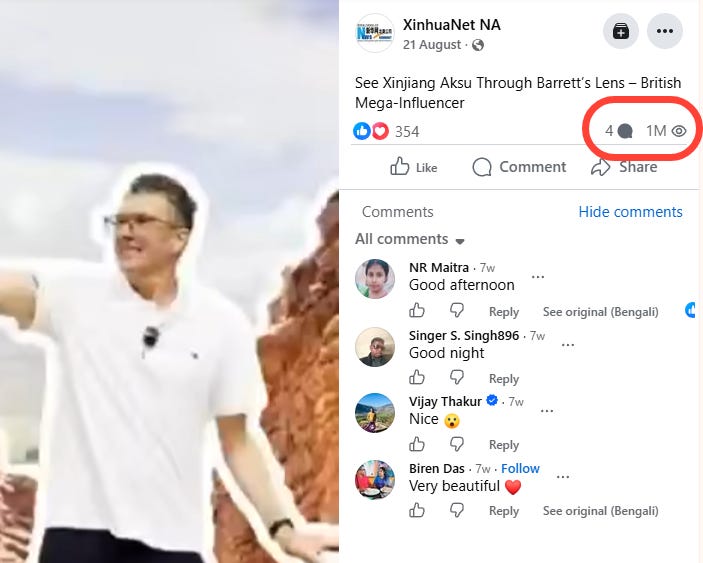
Well, take this 60-second montage of “Mega-Influencer” Barrett bumbling around Xinjiang. It hit a million views on Xinhua North America’s Facebook page — but just 354 interactions, and four comments underneath. That suggests the use of inorganic activity.
Don’t own general consensus? Simply fake that you do.
Rule-breaking?
However, the foreign influencers and the Chinese state are playing a dangerous game. And the hashtags establish a direct link between supposed ‘individual accounts’ and Chinese state propaganda campaigns.
Global platforms including YouTube, Meta, and TikTok all take firm lines on “Covert Influence Operations”.
TikTok defines COI’s as those “trying to deceptively influence social issues, politics… through hiding your account’s real identity or intent” — and especially if they’re “posting content on behalf of foreign entities (like a government or military) without saying so.” Accounts are instantly banned.
In the first quarter of 2026, YouTube terminated over 5,000 channels it found to be covertly linked to the PRC.
Incidentally, here’s a picture of influencer Andrea Randisi literally waving the flag for the Chinese state’s Xinjiang propaganda campaign, at its launch event.
In another twist of literalism, the flag was handed to him by Li Gang, a CPC official and long-time director of Xinjiang’s Cyberspace Administration.
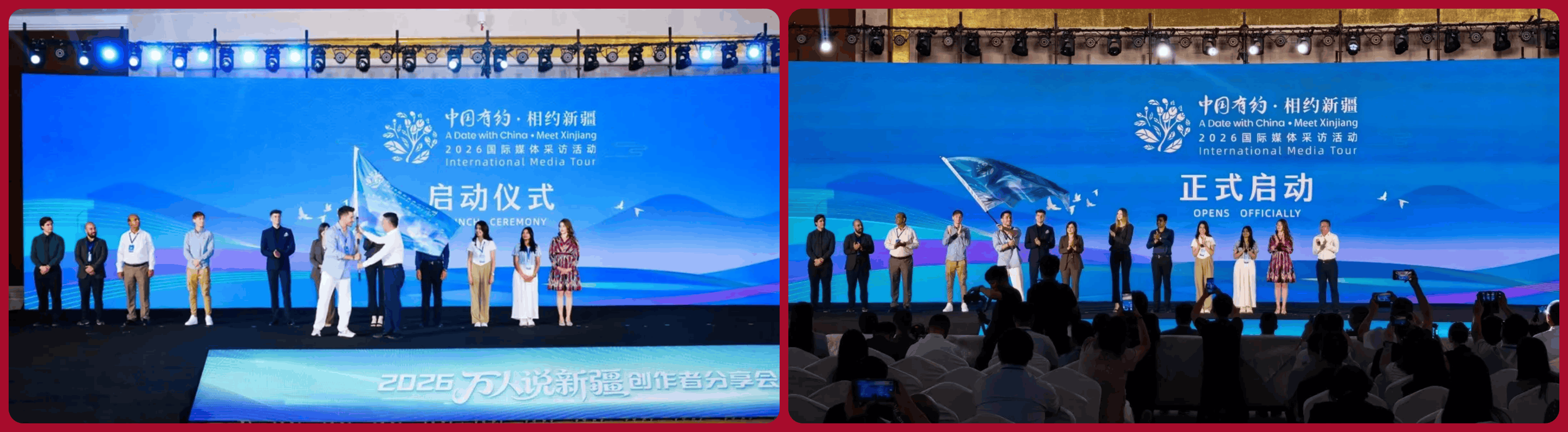
The influencers may try to be covert, subtle. The Party is not.
The tankie summoning this article generated has been useful, to see who is in the networks of support and to remind the world they are idiots. So once again, showing they are useful idiots. Genius
The freak-out this has provoked is something to behold. Dumbrill and Bertrand have responded with a frenzied flurry of ad hominems, red herrings, strawmen, legal threats, you name it, anything but actually addressing the point made very clearly, in the title of the article.
Tells you something.