
Beijing restricts journalists, yes, but foreign media keeps self-sabotaging too
Details behind NYT journalist's ejection; the BBC accidentally sets a new precedent on visas; and how China wears down reporters.

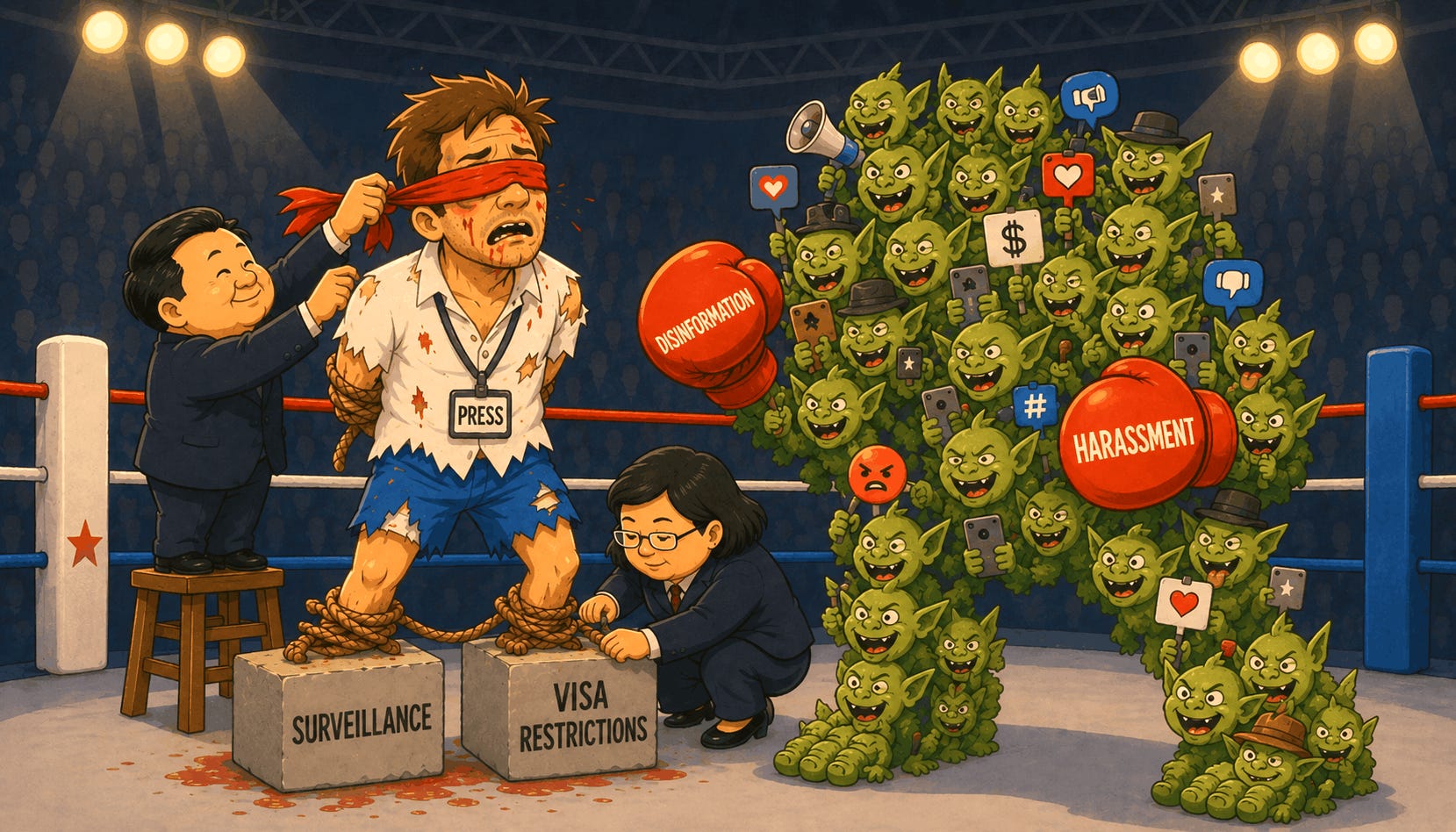
Being a reporter in China isn’t great. Out of 180 countries, RSF ranks it 3rd worst, a smidgeon better than North Korea. No country currently has more jailed journalists — 113 today.
According to the last Foreign Correspondents' Club of China survey, more than half of foreign journalists in China were tailed by plainclothes security that year — five percent were stalked by drone. This month, one journalist was even followed to his birthday party. A big, black SUV sat in the street, as he was inside cutting cake.
It’s undeniable that the Chinese state creates a hostile work environment, squeezing and pressuring those trying to report critically. And yet. A niggle rattles at the back of my head.
Yes. But you don’t always help yourselves.
NYT ejected
In December 2025, the New York Times interviewed Taiwan President Lai Ching-te.
In New York, blockbuster journalist Aaron Ross Sorkin introduced the pre-taped segment with the words: “His country is not merely a neighbour to China, it is a democratic self-governed island.” It was a bombastic opening, that smacks of a man who could make 600 pages about credit default swaps exciting, but perhaps is not the best for tip-toeing through the One China Principle.
Beijing noticed. Beijing was pissed. Reaction was swift. But not towards him.
Shortly after, the NYT’s China correspondent Vivian Wang, who was then on a trip to South Korea, was informed her visa would not be renewed.
News didn’t immediately get out. Industry rumours say the event was hushed as the NYT spent weeks trying to negotiate down the incident.
It’s surely a coincidence then, that in the interim, the NYT ran such hard-hitting pieces as "I went to China to see its progress on AI: we can’t beat it” or “China’s Electrostate Is Poised to Win From War in the Middle East; and fluff like ‘36 hours in Shanghai: historic architecture finds new life as galleries and dining destinations’. Critical coverage appeared, but was noticeably broader, dulled.
In mid-April, the news finally broke on Substack. The NYT didn’t comment until May. Wang was permitted to briefly re-enter China to clear her apartment. Almost instantly after, the NYT ran stories on state surveillance; China’s housing crisis; subdued economy; and interviews with overseas dissidents. Topics largely missing in the previous months.
But why Wang? How did a journalist with no input to the initial interview, become the scapegoat? Simply: she’s too good.
Like many foreign correspondents, Wang writes stories that China would hate: about Government coverups or ineptitude, or Uyghur and religious crackdowns. Those are uncomfortable, yes. But what really sets her apart, and what gets under Beijing’s skin, is her ability to seek out ground-level, everyday Chinese voices: Impoverished villagers freezing so Beijing can have blue skies; aging migrants unable to find work in the city; rural women left out of land deals. These are the very people the CPC claims it represents, helps, and is supported by. No wonder Beijing wanted to remove her access.
China can shoulder accusations by white men passing through, or faceless NGO reports lobbed from desks afar. What it can’t abide is a microscope, particularly from ‘one of their own’.
For years, Wang has been a hate figure for the CPC, and a focus of abuse for trolls online. Just scroll comments under the NYT’s X post about it. Some are on the state’s payroll.


Beijing maintains it removed Wang primarily due to the Lai interview. On June 1, an MFA spokesperson huffed: “The New York Times provided platform for Taiwan authorities to peddle separatist rhetoric for “Taiwan independence,” and blatantly called China’s Taiwan region a “country.”"
How much credence can we give that? Meh, not much.
Prominent media have conducted dozens of interviews with Taiwanese leaders through the years (here, here, here… etc); their reporting universally refers to the political leaders as ‘Taiwan President’ — all without recourse or punishment. If it is a red line, it is a new one. This week, a second media outlet admitted it’s been quietly frozen out of Chinese events, after interviewing Lai in 2025.
Beijing may be seeking to set this as a new precedent, as part of a wider squeeze on journalists reporting on Taiwan (see later). But, no make no mistake. Wang’s ejection was wholly opportunistic and personal.
Two months prior to the news breaking, I was tipped off that Chinese officials were giddy. One knowledgeable of the case had been openly bragging about Wang’s impending comeuppance socially. We’ve got her now, the official told a source, before realising their candour. “Actually. Forget what I just told you.”
On Wang, Beijing saw a chance to nix an irritant. So it did.
Weaponising visas
In May, the Wire China covered it in great detail in “No Country for American Reporters”. It particularly highlighted China’s push to drop foreign journalists down from a J-1 visa, to a J-2.
The difference between the two is immense. A J-1 is designed for foreign resident correspondents. It enables them to live and work in the country for a year or more; to enter and exit as they wish; to open bank accounts and put down roots. It provides journalists a semblance of protection. Traditionally, withdrawing a J-1 blows up into diplomatic spat (see Wang, above).
A J-2 visa, however, is a shell by comparison. Entirely temporary. Designed for one-off, single-entry visits — like reporting on sports events, or conferences. To do actual investigations on one is madness, as it brings an innate threat: one ‘bad’ story, or scandal, and you’re out. Journalists are effectively on parole.
According to the Wire China, “U.S. media outlets have not received any J-1 approvals at all since 2022”.
So how has this situation come about?
During Covid, the BBC appointed a new Asia Pacific bureau chief. The appointee had a decorated career, though little experience with China. They were keen to make a mark, to bring out a new correspondent. At that time, the Chinese authorities were being obstinately slow, with J-1 visas taking more than a year to be processed. “Can we get our candidate out faster?” Sure, the Chinese authorities posited, if the correspondent takes a J-2 visa instead. They didn’t actually expect the BBC to agree. The BBC did.
Delighted with this win, the Chinese authorities have reportedly pressed this arrangement onto other media, and are keen to install it as the new standard. Other media have since been told: “The BBC said yes, you will too.”
Desperate, several top international media have acquiesced. I'll omit names — but think the highest, most recognisable brands of print and TV.
Authorities are squeezing outlets in other ways, too. Fed up of Covid restrictions, and increasing general harassment, several out decamped their China bureaus to Taiwan. Now, Beijing has decided this, too, is a red line. Journalists, some on J-2s, are being threatened: “Leave Taipei, or we won’t let you enter China again.”
They’re holding firm. But for how long?
“We have chipped away at our standards”
Because I’m cool, I spend my evenings reading the Chinese media trade press. One recent story jumped out.
“More than 30 foreign media journalists from Bloomberg, AP, Reuters and other foreign media” toured Shenzhen’s robotics industry, the article bragged, adding that the two-day trip was “organised by the State Council Information Office”. For those who don’t know, the SCIO goes by another name: the Propaganda Department of the Communist Party of China.
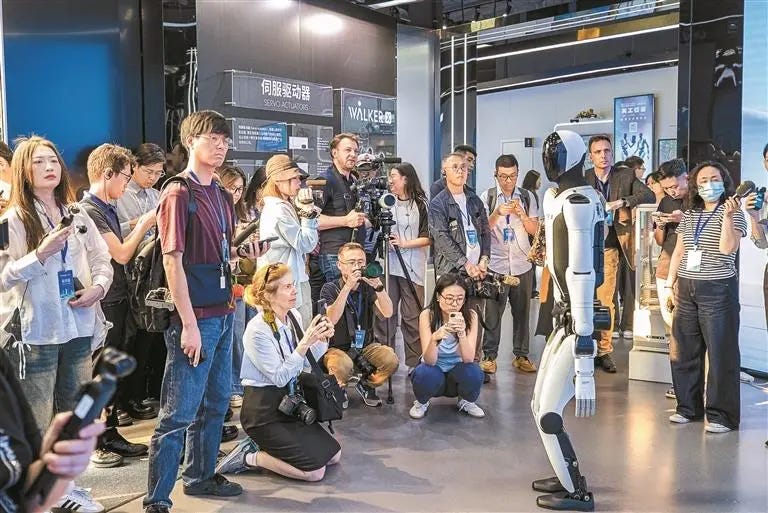
These junkets are nothing new — during my time, I went on plenty for China Daily and Xinhua. Predominantly, they were stuffed with domestic state media, very few foreign outlets bothered. At best, I’d see perhaps an African or minor European channel. Back then, most media deigned themselves above it. So what’s changed?
From speaking to reporters: they’re tired.
In the past, correspondents defiantly rebelled. They proudly saw themselves as the fourth estate: irritants, diggers of truths. Today, they are increasingly relenting. The work is becoming too hard. The personal price too high.
For more, read this report by Lynette Lim. It’s grim. Across interviews with nearly fifty journalists, Lim found the noose tightening. Foreign journalists detail how they are finding themselves increasingly shut out, harassed, and ignored in China. Under President Xi, the environment has become increasingly hostile and secretive, with sources — not just government officials, but everyday people — refusing to talk.
So far, so standard. China bad, China scary. But what caught my eye was some of the admissions. “We have chipped away at our standards,” one journalist bluntly says.
The impact of this can be seen. China stories are becoming homogenous. Many skimmed from the exact same political conferences, or rewrites of other’s stories. Easy busywork, a great way to meet quotas. Others are deliberately retreating into safe subjects, like: technology, consumerism, or quirky clips from Chinese social media. They might call it “being practical under trying circumstances”: another might call it a dereliction of professional duty, and abandoning Chinese voices that need hearing the most.
“I do self-censor,” says another journalist. “I was planning to go to Hong Kong…I didn’t write anything about Jimmy Lai or Hong Kong, which I might have otherwise done.”
I stare at the picture in Shenzhen News, recognising a few of the western faces. I wonder if it was worth it.
In 2008, China had 700 foreign journalists based there. Today it has 400. Partly that’s costs. Though, some of the more adept ones have been sniped out. There’s an uncomfortable question for those who remain: why am I still allowed here?
The antidote?
This time last year, I wrote: ‘China is winning the media war’ mostly as a rambling, dispassionate statement of fact, but also as a warning.
I didn’t come up with that aggressive term — it’s lifted straight from Chinese journals and meetings. It’s exactly how Party communications officials refer to it amongst themselves, the terms they think in. An “information war”. China versus the West. One the Communist Party must win.
To do so, Beijing has mobilized the whole state. Push, push, push, push. Unrelenting pressure. Media, government, cadres, citizens: focussed. Tell. China’s. Story. Well. And destroy those who don’t.
You could view the above as a series of ‘mistakes’. An interview set up provocatively by a drafted superstar journalist, to the cost of his learned colleague actually on the ground; an impatient BBC bureau chief; reporters self-censoring content today, to get access to possible content tomorrow; succumbing to free trips despite knowing their faces and firm’s reputation will be used for propaganda.
Every single one of those features an individual who’s taken an egocentric decision, and ended up advancing the CPC’s goals.
I don’t blame them. Under such duress, it’s easy to crack, to slack, to slip up, or not know you’re being targeted. The problem is the Chinese state is looking for weaknesses, naivety, laziness — constantly probing. And with each lax moment, it constricts tighter.

China reporting is a strange beast in that it’s both incredibly high-profile, highly politicised, and requiring adept navigation: yet is deeply, deeply undervalued. Scant resources. Little space. Too many people parachuted in, blunders waiting to happen.
My impression is that foreign outlets recognise they are under attack, though are yet to realise they are in a total war. They need resources. Those befitting covering the world’s second most powerful country, a population the fifth of the world, and a protagonist to nearly every major 21st century story.
And to send their best, people with actual China experience.
There’s more than enough floating around. Many here on Substack. Particularly in the UK, thanks to the recent decimation of Hong Kong’s civic society. You can’t move in London, for tripping over a listless ex-Hong Kong journalist. And within China itself, plenty frustrated there, too. Some even in western news offices. News assistants, i.e., the Chinese staff who do the uncredited dogsbody work, and take the most risk, yet are feeling increasingly despondent «This is a must read». Or the not one, but three state media workers who messaged me in the last few weeks, quietly asking if I knew of any escape routes or job opportunities. That’s a deep talent bench. Share the load.
Beijing has identified the way it will win positive PR is with less coverage, fewer outlets, flatter narratives. A blanket of social media posts pushing a handful of prescribed themes that it approves.
The opposite sounds the perfect antidote. Give me texture. Give me detail. Give China the coverage its size and importance deserves.
Someone once joked about being expelled by China was the best prize a journalist could win as they would have done something right there…
Excellent piece.